|
1
|
|
|
2
|
- A patented standard reporting format that unifies test results from all
data sources for users at all points of care
- Allows for complete cumulative patient information to be electronically
accessed and more easily analyzed
- Shared information that integrates test results data on all levels
(data, application, system and network) increasing efficiency, accuracy
and productivity.
|
|
3
|
- A physician-driven and financed Subchapter S corporation, founded in
Rhode Island by Robert D. Coli, MD and a group of physicians and other
private investors.
- Recipient of two consecutive United States Patents (first from June 29,
1979 to June 29, 1999 and current extending from April 9, 1998 to April
9, 2018)
- Up-front patent licensing fee paid in August 2000 by Idexx Veterinary
Clinical Labs.
- Working prototypes for common “MICROCHEM” tests developed in two Rhode
Island hospitals and now under development by a leading local EHR/PMS
vendor
|
|
4
|
- Time and cost savings
- Provides ease of use, access and sharing
- Quality summaries leading to fewer data errors and duplicate tests
- Improved workflow and efficiency for caregivers and outcomes for
patients
|
|
5
|
- Patient test result data from many dispersed sources Leads to critical
information being missed
- 30% of clinicians’ time is spent gathering and organizing data
- At least 20% of tests are redundant (unnecessary duplicates of others
already done but not accessible)
|
|
6
|
- Easily accessible clinical data
anytime, anywhere
- Time, energy and error saving
enables better care
- Integrates and logically displays complete test results information
- A mission-critical application designed by physicians for physicians
- Intuitive and user friendly interface
|
|
7
|
|
|
8
|
|
|
9
|
- Creating standards-based, technical computer system interoperability
presents only the first challenge
- For end users, the standardization, integration and design logic and
quality of the user interface is equally, if not more important.
|
|
10
|
- Only a high quality user interface and its logical data integration can
facilitate workflow and maximize productivity
- Added value of clinically indexed cumulative results in a standard
format VERSUS all existing variable formats displaying fragmented (raw)
data
|
|
11
|
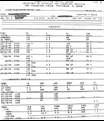
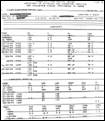
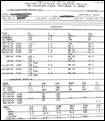
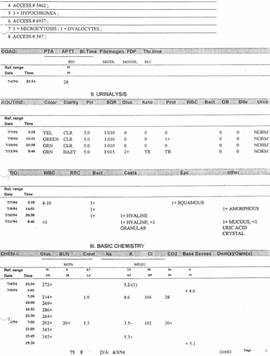
- (I) MICROCHEM Tests
- Five cumulative test categories (standardized and clinically
integrated)
- Tests on X axis and dates on Y axis (categories 1, 2, and 3)
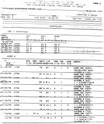
- Tests in four standard columns on Y axis and dates also on Y axis (for
categories 4 and 5)
- An average of 80 percent media reduction (pages and screens) and major
improvement in readability and trend analysis demonstrated at KCMH
(1979) and RWGH (1995)
- Opportunity for integrated test ordering (“integrated CPOE”) and
Clinical Decision Support System (CDSS) applications
- (II) SUBSPECIALTY Tests
- Fifteen cumulative test categories (standardized and clinically
integrated by organ system)
|
|
12
|
- (I.) MICROCHEM TESTS: (90% of
testing volume)
- 1) Basic Hematology Tests* (21 individual tests)
- Coulter: Hgb Hct WBC
Platelets RBC MCV MCH MCHC
- DIFF/MORPH: Polys Bands Lymphs Monos Eos Basos other RBC PLAT
- MISC: Stool OB Retic Ct ESR Fe IBC Ferritin B12 Folate
- COAG: PTA APTT BT Fibrinogen FDP Thr. time
- 2) Urinalysis
- ROUTINE: App PH SGR Gluc Keto Prot Hgb Bile
- MICRO WBC RBC Bact Casts Epc Other
- 3) Basic Chemistry Tests* (31 individual tests)
- CHEM-1
Glucose BUN creat Na K CL CO2 Base excess Osm(s)/Osm(U)
- ABG’s PH PCO2 PO2 O2 Sat CO2 content Bicarb Base Excess
- CHEM-II: Ca PO4 uric Mg Amylase Lipase Chol TG HDL LDL
- CHEM-III Bili-T Bili-D SAP GGTP SGPT SGOT LDH CPK
- PROTEINS TP Alb Glob Alpha1 Alpha 2 Beta Gamma
- 4) Special Chemistry Tests*
(3,500 individual tests)
- TESTS RESULTS REFERENCE RANGES UNITS
- 5) Microbiology Tests
- ORIGIN MICRO CULTURE SENSITIVITIES
- * the specific subcategory content and
format specified in the U.S. patent claims.
|
|
13
|
- II.) SUBSPECIALTY TESTS: (10% of
testing volume)
- 1) Cardiovascular
- 2) Respiratory
- 3) Digestive
- 4) Endocrine
- 5) Hemic & Lymphatic
- 6) Nervous
- 7) Eye & Ocular Adnexa,
Auditory
- 8) Musculoskeletal
- 9) Integumentary
- 10) Urinary
- 11) Male/Female Genital
- 12) Maternity Care &
Delivery
- 13) Immunology
- 14) Pathology; Cytopathology;
Transfusion Medicine
- 15) Genomic Medicine
|
|
14
|
- Challenge: To efficiently manage the billions of annual results of the
thousands of different diagnostic tests
- Imperative: Today’s emerging interoperable HIE era must avoid
perpetuating the test results "Tower of Babel" hallmark of the
paper-based and "information silo" era.
|
|
15
|
- Fully standardize and clinically integrate the user interface format
- Ensure that RHIOs/HIEs, EHRs, PHRs and CDMSs can efficiently display lifetime patient
test results in the same way for physician and patient viewing and
sharing.
- The patented DISsm methodology was designed, and has been
perceived by test users as the clinically logical and interoperable
solution to an IT problem shared by all RHIOs/HIEs, EHRs, PHRs and the
NHIN “network of networks”.
|
|
16
|
|
|
17
|
|
|
18
|
- Sharing Test Results Information in the Same Way
|
|
19
|
- Standardize and clinically integrate the display of all diagnostic tests
for the statewide RI HIE Project by granting the U.S. patent rights to
the state as an in-kind contribution.
- Rhode Island will develop and deploy this nationally replicable,
clinically logical display format and share it with other leading HIEs
and their contracted HIT vendors.
- Rhode Island and other states will produce private sector income to
sustain HIE operations and expand its services by sharing in royalty
payments based on sales of the
DIS format in other states.
|
|
20
|
- The goal:
- Solve an important industry problem for the first time in Rhode
Island by displaying and sharing
all test results in the same standardized and clinically logical way to
end-users. (“Anytime, Anywhere Test Results,”)
- Share the DIS technology solution with RHIOs and HIE-contracted HIT
vendors in all other states. (“Lifetime Test Results 24/7”).
- The objective:
- Generate private sector funds to sustain long-term HIE operations in
Rhode Island and other states by licensing, developing and using a
physician optimized clinical HIT innovation. (“Doing well by doing
good”).
|
|
21
|
- The nation’s most pressing problems in healthcare cost and quality
require more than just incremental innovations.
- Disruptive simplification technology innovations, including the DIS
clinical standard format, technical transmission IT standards, HIT
systems certification,and a secure HIT infrastructure will all work over
time to support a value-based competitive healthcare marketplace.
(www.hhs.gov/valuedriven)
- Only such a market, by properly aligning
stakeholder incentives, capital sources and the interests of HIT
buyers and vendors can ensure the development and sustained improvement
of a robust national HIT infrastructure.
|
|
22
|
- Paper Bureaucracy and “Information Silo” Era:
- Reporting and sharing of patient test results in the $2+ trillion U.S.
healthcare industry based on
paper, telephones and fax machines. (”The excellence of the status quo
is a sentimental illusion.”—Donald Berwick, MD):
- Ambulatory and hospital EHRs and the few fully operational HIEs display
share and print test result reports using a variable, fragmented format
design. No standardized, clinically logically format is yet available
that integrates (unifies) results from different data sources. (Legacy
industry business model:
“Physicians want customization, not standardization.”)
- Universally negative results for all stakeholders: Unacceptable rates of
test duplication (14-30%) and medical errors and an enormous waste of
time and money. (“The definition of insanity is doing the same thing
over and over again and expecting a different result.”—Albert Einstein)
- Emerging Interoperable HIE Era:
- Data integration and interface usability are paramount and sharing all
healthcare data types in the same way is mandatory. (“Know where to find
the information and how to use it. That’s the secret of success”—Albert
Einstein)
|
|
23
|
- High Costs & Risks:
- HIEs, the NHIN, EHRs and PHRs
perpetuating the status quo by reinventing the test results reporting
“wheel” 500+ times.
- Low Costs & Risks:
- Immediately solve the test
results problem statewide and generate sustainable private sector earned
income for RI HIE Project
operations by partnering with the DIS Company EDS,
InterSystems Corp. and Health Language, Inc.
|
|
24
|
- Strategy of multiple public-private patent licensing partnerships offers
the Rhode Island HIE Project and its emulators in other states low risk
and high ROI in creating an essential clinical IT functionality with
tangible financial, patient safety and quality of care benefits.
- Multiple Tangible Benefits: Rhode Island as the first state-level HIE to
solve the test results information management problem. Replicable in all
other states and internationally. Creating a new sustainable private
funding source and an additional electronic success story from the Rhode
Island EDC’s Business Innovation Factory (BIF).
- NEXT STEPS:
- Collaborating with RIQI, RIDOH, and their chosen IT vendors EDS,
InterSystems Corp. and Health Language, Inc. to incorporate the unique
DIS functionality into the Rhode Island HIE Project
infrastructure.
- Continuing the development, testing and roll-out of the DIS standard
format in Rhode Island as a value-added feature of Polaris Medical
Management’s Epichart EHR, other CCHIT-certified EHRs and the ERcard,
LLC stand-alone PHR.
|
|
25
|
|
|
26
|
|
|
27
|
|

 Notes
Notes